Cool Drawings of Chemistry Tumblr
nature graphics

CONTROL Issues
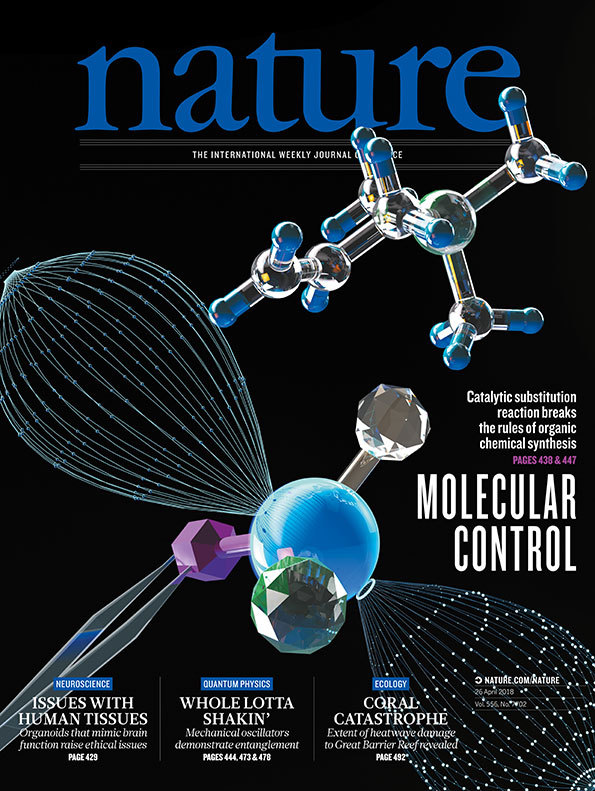
Background. Fourth dimension to re-write organic chemistry textbooks: a catalyst has been developed that recognizes the topology of merely ane face of a planar reaction intermediate. Remarkably, this enables 1 mirror-epitome isomer of the reaction product to be made selectively.
In a nutshell, the research describes a new style to concur a molecule in place at a detail orientation. This piece of work volition presumably enable future researchers to explore a vast new 'chemical space' of all possible molecules. (An attainable summary of the enquiry can be found in this excellent News & Views slice. Paywall)
Design challenge. Unlike some papers in Nature, this one is not easily understood past those outside the field. When we decided to feature it on the cover, nosotros knew it would exist a claiming to visualize. We called for aid - and expert scientific illustrator Ella Marushchenko answered! Ella has created many striking journal covers in the past, and then nosotros knew she would exist upwardly for the challenge.
This from Ella near her process:
"In the commodity, scientists described a new way to hold a molecule in place at a particular orientation. 'Directing the undirectable' was the working encompass line at the outset of the projection, and helped inform our thinking. One of the ideas which came from the editors was to evidence a trigonal planar cation being held in place by the goad, with the attacking group coming from the other side. We worked with corresponding author Eric Jacobsen to refine this idea. He helpfully sent us ChemDraw files of the molecules, and worked closely together with Kelly and me on the embrace image.
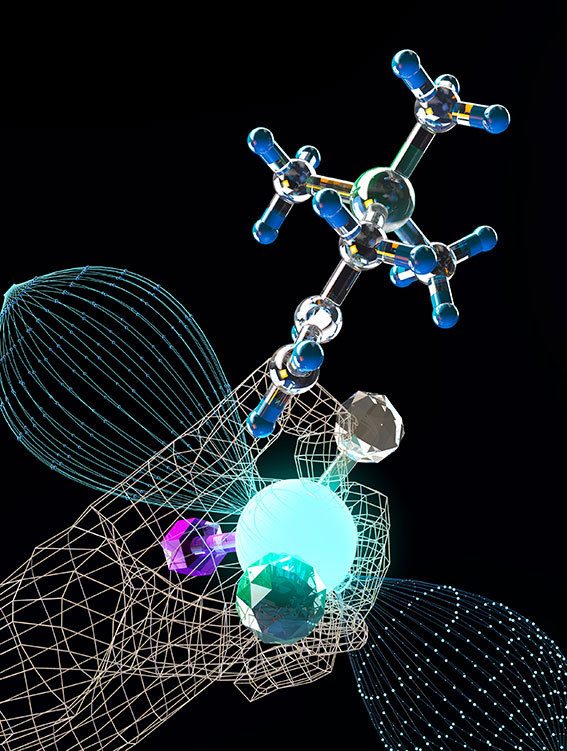
Our claiming was to visually convey the idea that a molecule was being controlled. This requires some sort of visual metaphor that people can chronicle to. The first thought was to show the molecule being held by a manus. Modeling of the hand is ever a challenging part for me because the hand should look anatomically right and elegant. To model a manus property something I always look at my own mitt and try to see information technology from unlike angles. I took a 3D printed molecule and started rotating information technology to detect the best perspective.
While I was doing it my cat decided to assist me and played a role of the attacking molecule, displaying previously undiscovered acting talent (2nd image).
Kelly asked me to evidence the hand in a wireframe style, to make information technology more than symbolic than realistic, and I agreed with her because I really similar this mode. I decided to show all molecules in 3D with reflective materials. To bear witness the divergence betwixt the three substituents on the intermediate, I decided to apply not simply shape and color, just too different numbers of polygons. In this mode the divergence between three substituents was obvious.
One of our first drafts shows the wireframe hand holding a molecule in place (tertiary image). While this overall composition works well, the thought of using the paw did not work out. The mitt overlapped oddly with the trigonal planar cation, and was too large when rendered from that angle, which distracted from the molecule itself. Afterward some word, nosotros decided to try something less prominent than the mitt, agreeing to prove control by tweezers (final cover, top image)."
Summary. This cover was an interesting do in finding the right metaphor to communicate an esoteric, complex idea to an audience of not-specialists. As Nature is a multidisciplinary journal, nosotros walk a line betwixt getting the essentials of the fine art right for specialists, while at the aforementioned time creating a dynamic and understandable image for scientists outside of the field.
The design solution of the tweezers enables the non-specialist viewer to understand that molecular control is happening, merely without having to recall besides deeply about what is doing the manipulating. Or, for that matter, who owns the paw!
-Kelly Krause


THE MASER, AND HOW TO CAPTURE LIGHT WITHOUT SPECKLES
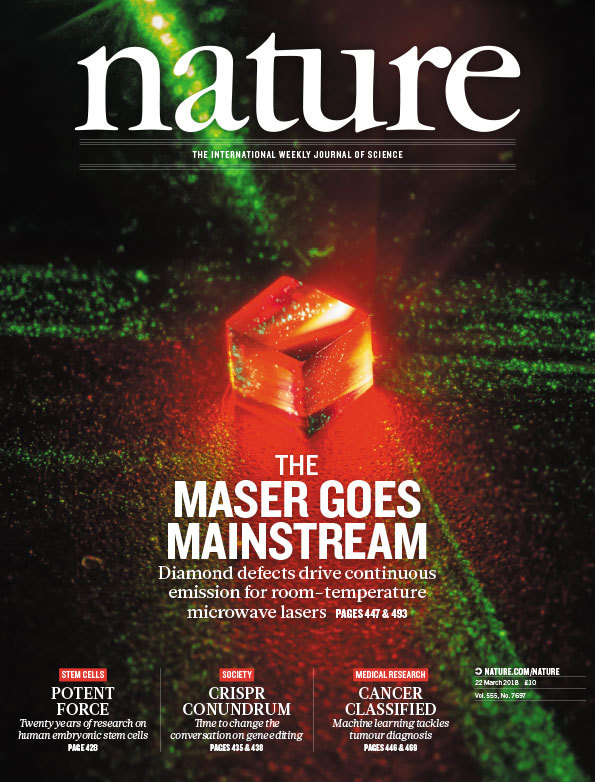
Background. The ubiquity of the optical laser means that it is easy to overlook its elder sibling, the maser (substantially a microwave laser). First developed in 1954, half-dozen years before the light amplification by stimulated emission of radiation, the maser has not been every bit widely used as its optical counterpart, equally masers take historically required conditions of loftier vacuum or extremely low temperature to operate. However, they found application in radio astronomy and deep-space exploration because they offered unparalleled operation as low-noise amplifiers.
This week, Jonathan Cakewalk and squad report, for the kickoff time, a maser that works continuously at room temperature.
Blueprint challenge. We received some striking comprehend submissions from the inquiry team (second image from the top), but they weren't quite high quality enough for a print embrace. Nosotros asked them if they could produce meliorate versions without the speckle effect, which we assumed would be a simple affair, merely it turned into an interesting visualisation challenge. I've asked author Jonathan Breeze to certificate his process for us.
This from Jonathan:
"When submitting cover images for consideration, you are aware that the images practice not need to be scientifically accurate and can afford some abstraction and artistic licence.
The maser itself is an incredibly unproblematic device: a cuboid of dark crimson diamond sits within a colourless and transparent sapphire ring. These 2 are fixed inside a cylindrical copper can, supported by a hollow quartz rod.
Our first approach was to deconstruct the device a piddling and take a photograph, only we plant that the main signal of involvement – the diamond – was obscured past the sapphire ring and quartz tubes. We deconstructed some more than, showing just the diamond and the sapphire band, with some white backlighting from a smartphone torch. The event was pretty – the diamond'southward pinky regal hues more evident – merely it yet lacked touch on.
Thinking most how the maser works – a diamond excited by green light amplification by stimulated emission of radiation light – led to the thought of using a handheld green laser pointer to illuminate the diamond within the sapphire ring, producing a reddish glow from the diamond due to fluorescence.
The results were quite dramatic and abstract. The composition was good, simply there was a problem with "speckle patterns" (third prototype from top). These announced as random dissonance and are caused by interference betwixt photons scattering diffusely from rough or irregular surfaces. Lasers are peradventure the harshest of light sources, revealing every slight defect, scratch or fleck of dust in addition to arable speckle noise.
The size of the speckles is of the order of 2.4λL/D where λ is the wavelength of light, L is the distance from the object and D is the diameter of the lens aperture. An estimate of the speckle diameter was 5 micrometers, which is greater than the width of pixel elements inside a photographic camera CC chip (ane micrometer). Reducing the speckle bore to beneath this might aid reduce the dissonance, just it wouldn't be eradicated completely. Nosotros sought a better photographic setup likewise – Canon EOS 5D Mark III camera instead of camera phone (hangs head in shame).
There were a few routes nosotros could explore in order to reduce the prominence of the speckle patterns, although a number of physicist colleagues we spoke to insisted it was a beautiful phenomenon and besides useful. Even so, when blown up in print, they are somewhat unsightly.
Wavelet de-noising algorithm. This technique is very effective at removing dissonance without blurring out the edges of features. However, when in that location is mostly speckle design in certain areas of the image, the de-noising algorithm left inhomogeneous blobs of green. Information technology did, even so work well where there was less overall speckle.
Light amplification by stimulated emission of radiation speckle reducing device. These devices work by vibrating or rotating a frosted glass diffuser plate. It reduces speckle significantly, but increases the axle diameter. This resulted in greater illumination of the sapphire by green light, but unfortunately a lot less of the red fluorescence from the diamond.
Say cheerio sapphire. The sapphire ring, although interesting, was the main cause of scattering and therefore speckle. When we removed it and merely lit up the diamond with the laser, we had significantly less speckle (especially over larger areas), there were visible light amplification by stimulated emission of radiation beams and too a lot more red fluorescence coming from the diamond. The images were hit. Stuart Penn of Framestore processed the image to remove every bit much speckle as possible without losing features.
Kelly Krause liked our first attempt, although the colour of the diamond was a petty saturated, and then we tried once again with a amend macro lens (65mm Canon MP-E). This produced a beautiful epitome of the diamond cube with very fiddling speckle – only some dark-green scattered calorie-free from pits in the diamond surface – and far less greenish laser beam.
Kelly had the bright thought of combining the two images to create a blended (bottom prototype). The faces of the diamond from the most recent image would exist copied and superimposed onto the previous image using an affine transformation and then that the cube faces matched the geometry of those of the the diamond in the original image."
Cheers to Jonathan and Imperial College lensman Thomas Angus for your perseverance and de-speckling tips.
-Kelly Krause


HUMAN VERSUS Auto
Background. Each Dec, Nature produces Nature's 10: a option of 10 people who mattered in science that yr. Past covers have shown a "10″ in a fun way related to a relevant scientific theme. This year, we decided to highlight bogus intelligence.
Design challenge. Only what does artificial intelligence wait like - how does one visualize AI every bit art? We gave this challenge to Martin Krzywinski, data visualisation artist extraordinaire and staff scientist at Canada's Michael Smith Genome Sciences Centre. Martin created a stunning black and white "10″ for us, created using a single line (height epitome).
It immediately appealed to u.s.a. every bit a representation of what a machine derived image might wait like, just the story is a bit more nuanced, as explained past Martin (below). To me, the black and white speaks perfectly to how some view AI at the moment - so much hope (represented by white) but with a dark side, the much discussed black box of AI.
This from Martin, explaining how the cover design process itself was in a mode a dueling friction match betwixt human being and motorcar:
"What do we mean when nosotros say that something is "interesting" to look at? Organized and symmetric or decorated and convoluted? Tin an optimization algorithm be used to generate compelling design by finding a balance between these properties? How would such a balance exist computed?
For the 2017 Nature "10" cover, I wanted to reflect the themes of artificial intelligence into a design that at first glance would be challenging to understand or perceive, but encourage the middle to find the design.
Computational approach. To practise this, I interpreted the shape of the digits of ten using the output of a car learning algorithm that solves the travelling salesman problem (TSP), in which a prepare of points is continued past the shortest closed path (Fig. 1). This procedure starts by first representing the image, in this example the "10", as a fix of points (Fig. 1A), repeatedly running the TSP solver and selecting the shortest solution.
There is a sure satisfaction when looking at the automated solutions in Effigy 1—they provide the solution to a trouble that cannot exist manually solved. On the other paw, are these intellectually compelling shapes visually highly-seasoned? Where the path generates diagonal cracks in the 10 in Figure 1C is in stark contrast to the otherwise highly ordered weaving of lines—is this combination of order and disorder in balance? Computationally, aye. Visually, I would say not.
Trying it manually. To comprise design decisions into the process, I created manual solutions that were less short and, I hoped, more interesting (Fig. 2). By starting with a series of guiding lines (Fig. 2A), the offset attempts were quite messy (Fig. 2B), followed by ones in which the boundaries of the letters were formed by bends in the lines (Fig. 2C) and finally with paths that looked closer to the TSP solutions in Figure 1, but without the cracks.
The paths in Figure 2C vibrate on the folio—they are visually striking merely don't concord my eye's attention. For case, as shortly as y'all effigy out that the lines in the eye zig-zag across the page, there is no more than mystery. Figure second doesn't assail the heart every bit much, just follows a recipe (the path snakes across, as much as possible) and one time this is quickly discovered, the center wonders off. The messy accept in Figure 2B is a combination of these—there is a diverseness of ways in which the many paths can bend and run off the page, which make the image more of a maze (the lines tin be the path or the walls). It's a visual trap and this was the arroyo used to blueprint the static cover paradigm.
Animation. For the spider web version of the issue, we used the shortest path from Figure 1B together with animation to show how the path evolves—something that is actually quite interesting but impossible to communicate achieve in a static epitome. We explicitly marked the start and end of the path to grade the x (Fig. 3A) using ">" and "Finish" and then connected the within of the zero to make full the infinite (Fig. 3B). Simultaneously, the background, which is also rendered as a single path, was animated, and then that the screen completely fills over time with a pattern that closely follows a TSP solution.
You may have experienced some discomfort looking at some of the images. This is due to lateral inhibition in the retina, a process in which light and dark field receptors compete. I explored ways in which this outcome could exist mitigated, such as the use of tone and various line thickness (Fig. 3C), only ultimately decided on the vexing intrigue of the loftier-contrast version."
___________
As a case study, this seems to support a notion that humans design for humans, while computers design for computers. Fair enough, every bit long every bit we examine how and why they practise it.
-Kelly Krause


KANDINSKY MEETS MORPHOGENISIS
Background. This design was for the 2017 cover in an almanac serial of biology review supplements well-nigh challenges in various biological fields for the coming twelvemonth. The articles are on different subjects, with no topic linking them. I take ever taken inspiration for these covers from the paintings of Kandinsky, and have institute his mix of organic and geometric shapes to fit the subject matter well.
Blueprint challenge. For this cover, I wanted to produce a piece of artwork that didn't closely follow a particular Kandinsky painting. I wanted the design to be dictated by the articles themselves, and for the color scheme to develop naturally.
Ideas and sketches.Afterward reading over the manufactures I idea that the ones on morphogenesis, patterning and development were the ones that would piece of work best as a basis for my design. I picked out element from two figures. I also looked round for other diagrams on the web that related to drosophila embryogenesis. I then sketched out some ideas (2nd image, in a higher place) making the patterning and folding of the drosophila from to be the main focus. Beneath this, I wanted to have patterns that represented cistron expression profiles, that were floating upwards from Dna. I wanted the whole pattern to piece of work upwardly from Dna at the bottom, through gene expression, to developmental genes, and patterning and segmentation at the top. I then worked these ideas into a final typhoon.
Development and terminal artwork. In the last design (top image) I decreased the size of the main drosophila element and added shapes to rest it on the left. I wanted these to represent 3D development of grade, then they morphed from grey and flat to dark with more depth at the forepart.
For my concluding colour scheme, I wanted the red and yellow in the stripes on the embryo to actually pop from the more than subtle dejection and purples of the rest of the design. I used brushstrokes across the embryo to represent gradients of expression and of chemical signals that result in segment formation. I added dots and arrowed triangles to further emphasise the signalling gradients in action.
-Nik Spencer


MAPPING HUMAN Movement
Groundwork. We recently published a special issue exploring the intersection of science and man migration. Researchers warn that misleading reports almost the size of flows into Europe and United States are creating unjustified fears about refugees. That is compromising efforts to manage the humanitarian crisis faced past people fleeing war-torn countries. The numbers evidence that the vast majority of refugees from Africa and Asia sought refuge in neighbouring countries. Only small proportion chose a long and often perilous journey to Europe.
Design challenge. We set out to tell this story visually. Although the original brief for this project included a map every bit a main element, nosotros ultimately took a different visualization arroyo. During an ideation session, we used hand drawn sketches (second image, above) to discuss graphic elements and limerick, including refugee flows, locations, historical data and changes in migration.
Both the main print graphic (top image, above) and our interactive version (bottom epitome) were based on a data visualization by Nikola Sander at the University of Groningen.
Impress graphic. For the impress version all the major region-to-region flows and top viii state-to-country flows were selected. Since we institute the original circle nautical chart hard to empathise, we decided to get with an alluvial diagram instead with region of origin on the left and destination on the right. Nosotros and so used the online visualisation tool RAW from Density Design to plot the data and export it as a vector file.
One of the main challenges for the print graphic was making sure the network of lines in the alluvial diagram would be understood by the readers. The interactive nautical chart allows users to switch between region and country views and displays additional info on hover. Of form that is something impossible to recreate in a static version for print. For the print version we wanted to discover the right balance betwixt showing as much data equally possible and making the chart clear and like shooting fish in a barrel to digest. Highlighting the peak 8 country-to-country flows was the editorial compromise that seemed near sensible selection to everyone.
Interactive version.For the interactive graphic, Nikola very kindly shared her data and code with us so that we could embed the graphic in our article online.
Still nosotros had problem getting the round design to fit within our slightly narrower columns. Also our journalist on the project, Declan Butler, was concerned that showing migrants, refugees and asylum applicants together would be confusing. Every bit Nikola notes 'every refugee is a migrant, only not every migrant is a refugee'.
Taking inspiration from the website http://peoplemov.in, we opted to present the refugee information as a 'sankey diagram'. Sankey diagrams are used primarily past engineers to demonstrate energy transfer just they are as well neatly suited to showing the movements of people. The resulting diagram is very tall, simply nosotros found it intuitive enough to scroll up and downwards the page to follow the connections and hoped that our readers would feel the aforementioned way.
The terminal graphic was built with a Sankey Diagram plugin for the popular javascript library, D3.
As a default the plugin works to position the nodes, or in our example countries, so that there is minimal overlapping amid the connecting lines. This makes for a less confusing graphic, withal it didn't make sense for the countries to be bundled in a semi-arbitrary order. We tweaked the algorithm and so that the countries could be bundled either by continent or by descending totals of people entering or leaving.
The code used to build the graphic is bachelor online at Github.
- Jasiek Krzysztofiak and Chris Ryan


OUR SEVEN SISTERS
Groundwork. Seven planets whose surfaces could harbor liquid h2o have been spotted around a nearby dwarf star, TRAPPIST-i. All seven are of comparable mass and size to earth, orbiting a depression-mass star roughly the size of Jupiter. If like configurations are mutual in planetary systems, the Milky Mode could contain multitudes of World-like planets.
The planets were revealed through photometric monitoring from the ground and space, in an effort that began in 2010 with a robotic telescope called TRAPPIST in Chile, and also included 20 days of continuous monitoring with NASA's Spitzer Infinite Telescope.
Design claiming. Writer Michael Gillon and squad sent forth a cute set of embrace submissions. Nosotros decided to go with something a bit non-traditional - rather than a straight creative person conception of the planets in infinite, we went with a version that shows the organization every bit a model on a tabletop, to illustrate an important point well-nigh the possible being of water (in diverse phases depending on location: steam, liquid and ice).
The cover was created past Robert Hurt, a visualization scientist at Caltech who works with NASA.
We asked him most his process. This from Robert:
"It's a rare opportunity to be able to work on a science result equally exciting equally the discovery of a planetary system with seven Earth-like planets, so when designing a concept for cover fine art I wanted to notice an arroyo that would embrace the science points but with a fun artistic angle that could complement them. The core points in this paper are the number and size of the planets, only too the thought that due to the system configuration that liquid water could be possible potentially on any of them.
Early the idea of arranging the planets on a tabletop sounded promising. With artwork being adult for all seven planets by myself and my colleague Tim Pyle it would requite a lot of visual interest to the tabletop marbles. To work through the ideas I really dug upwardly a marble collection and played with them on my floor until I found something that looked appealing, and the concluding layout actually came very close to that initial experiment (run across second photo, above).
The color of the star TRAPPIST-i was the adjacent chemical element to resolve. Traditionally, absurd 1000-dwarf stars have been rendered as securely cerise as their spectra ramp upwardly strongly at longer wavelengths. Nonetheless, examining the spectrum from a similar star and comparison it to the homo heart colour responses to ruby, green, and bluish, information technology was evident that something closer to a salmon-orange color would exist more right, similar to a low-wattage lightbulb. Notwithstanding since I wanted to highlight some features on the back side of the planets, including water ice caps, calculation some extra fill light (easier to justify in a photography studio than in space) did the trick.
Finally to tell the story of water it seemed that having a little water spilled on the tabletop would connect the planets to the possibility of water. By showing the water in all three phases, steam closer to the star, frost and water ice further abroad, the concept of the habitability zone could exist made intuitively, without the usual band of greenish. There was an alternate version that showed a lab beaker with water to motivate the spill, only ultimately nosotros converged on the view without the beaker as being the most on-topic."
-Kelly Krause


WHAT'Southward KILLING THE WORLD'S SHOREBIRDS?
Background. The decline in shorebird populations is alarming – their numbers have shrunk past 70% across North America since 1970, with species breeding in the Chill among the hardest striking. Although the population crash is well established, the underlying causes are not always sure. That'southward because the birds travel thousands – sometimes tens of thousands of kilometers a year – encountering many different threats forth the mode. The race is on to figure out what problems are almost responsible, with the hope that some protections tin can be put in place to help the birds bounce back.
Ane research method is to runway the birds. New generation nanotags, satellite trackers and geolocators are providing unprecedented item on the journeys of shorebirds, which make some of the longest migrations in the brute world. The Motus tracking system uses inexpensive off-the-shelf engineering for its 300 receiving stations deployed across the Americas, tracking birds with nanotags that are glued onto their backs.
Pattern challenge. The first challenge was establishing the size and scale of the graphic. It wasn't planned every bit a two-page infographic initially, but rather a smaller graphic accompanying news story. We shortly realised that we had enough unique information for a larger stand-alone graphic.
The primary design challenge was complexity. The graphic is attempting to combine two different stories: one) the bird tracking arrangement, comparing types of devices, and showing the network map and the flight paths; and 2) threats to shorebirds, which was the main betoken of our accompanying news story. Our ambition was to create a clear and logical visual narrative where these ii stories overlap.
For the sake of clarity, we used different headline styles and icons to layer the data and create visual hierarchy. Ane of the things we decided not to include was the extent of the red knot population itself. We knew the birds breed in the arctic and fly s for the wintertime only the data was kind of vague and we're committed to utilise reliable sources. Besides, nosotros thought that calculation more layers of data would clatter the map and brand it harder to read.
The graphic also required collaboration with experts. Nosotros enlisted scientific illustrator Emily Cooper to create the gorgeous illustration of the scarlet knot and the tracking devices. Nosotros also worked together with researchers who provided geographical information. This required us to acuminate our GIS software skills in order to create the map.
-Jasiek Krzysztofiak


Background. NASA is planning another Mars rover – its most ambitious yet – to launch in 2020. A chief goal of the mission is to collect samples of rocks and store them in some of the cleanest equipment ever made. Those samples volition eventually be returned to Globe to test for evidence of life and clues to the planet's history.
Design challenge. The aim of this graphic was threefold: to highlight the main features onboard the 2020 rover; to explore the program for clean storage of samples; and an overview of the entire mission, from landing to soil collection to launching the samples back to Earth.
I of the main challenges for the graphic was our tight timeframe, equally we simply had a couple of days to complete the two-page graphic. In order to salvage time we used visual materials from NASA, for instance the splendid 3D model of the rover and the Mars mural background, photographed by rover Opportunity in 2015. Other bits - similar the helicopter and the sampling tube - were illustrated past us, based on information from the space agency.
The "Sampling and caching" department of the graphic went through a series of alterations. In the concept stage (see sketch, 2nd image) we imagined this to be a detailed visual explanation of the drilling technique and sample collecting process. However, we were unable to pin downwards the exact details of the method as it turned out the researchers are still conducting experiments and haven't settled on the final design. After a serial of conversations and sketches nosotros decided to simplify this part and only testify what nosotros actually do know – the design of the sampling tube and number of tubes carried by the rover.
-Jasiek Krzysztofiak


Half-dozen YEARS OF 10
Background. Each December, Nature selects 10 people who mattered in science that year. We've been doing this for six years now, and this year's listing is as insightful as ever, with fascinating personal stories.
Pattern challenge. Each year we evidence a number 10 on the comprehend in a science-y fashion. This yr information technology relates to a big effect in science from 2016. Can you judge? (Hint.)
This twelvemonth'due south fabulous cover was created past JVG. While it may wait sleek and elementary, getting the waves and grid just right in the 3D render was no easy task. (A physicist was enlisted to assist at one indicate.) The stop result is stunning - thank you JVG for the absurd take on space time.
-Kelly Krause


Edifice QUANTUM MATERIALS WITH MICROSCOPES
Background. Electron microscopy: not merely for imaging! Before long the tool could be used to create structures, atom by cantlet. This sort diminutive architecture could transform our basic scientific understanding of materials and pave the fashion to new classes of devices for quantum computing, spin sensing and more.
How? Electron microscopy is reliable and widely used to view thin sections of materials. It uses a beam of electrons to reveal the material's crystal structure. While doing this, the beam tin can nudge atoms out of alignment and change the material's form. This is a trouble for imaging, just could be a benefaction for fabrication — as long equally the modifications can exist controlled.
In a slice published today, experts explain how information technology works and what needs to be washed to brand the 'atomic forge' a reality.
Design challenge. We learn new concepts by trying to visualize them, even if we are not always witting we are doing it. In cases like this i, where the process is cut-edge and the concept new for most readers, nosotros idea a clear illustrated diagram would greatly aid comprehension.
We started with an fantabulous sketch from Stephen Jesse, ane of the skilful authors of the piece (second image), which he created in Blender. Information technology gave us a sense of the full general process and structure of the atom forge. We then enlisted scientific illustrators from Xvivo to create an illustration in collaboration with Stephen (top image).
This from the talented artists at Xvivo about their artistic process:
"The challenge with the illustration was that the concrete structure of the diminutive forge doesn't exist notwithstanding. Therefore, it was our intention to give the analogy plenty detail to be a conceivable and impressive machine, while leaving certain pieces of the structure more than ambiguous, waiting to be filled in with new ideas and innovations.
Since fabricating new materials is the goal, we wanted the master focus to be at the site of the beam forging new materials. From there, the composition of the piece loops around to illustrate that the process works based on a feedback arrangement. The layout conveys the cyclical process: the beam manipulates the material, the sensor below receives the diffraction pattern, the patterns are sent to the computer, the software informs the axle position, and echo. We also incorporated blue wires through the structure to reinforce the concept of connecting all of these technologies together in order to form something new.
While the illustration contains details recognizable to experts, such as a reference to qubits and diffraction patterns, the overall construction was distilled to be digestible across a wide audience, just as members from many disciplines are needed to make the thought a reality."
PS. They also created a fantastic animated version.
-Kelly Krause
Source: https://naturegraphics.tumblr.com/

Postar um comentário for "Cool Drawings of Chemistry Tumblr"